Faceless YouTube Channel Ideas: 70+ That Still Work in 2027
70+ faceless YouTube niches, and 12 automation workflows to build them.


TL;DR
- 12 niches, each with a full AI automation build.
- Educational explainers are the most competitive niche on the list.
- Motivational content is the most saturated, a distinct angle beats the format itself.
- Finance and history niches need real, sourced research, not just AI-generated scripts.
- Ambient/sleep content flips the cost math, if viewers actually stay.
- No niche fits? Take a proven format and point it at an untouched subject.
Most posts about faceless channel ideas give you a catchy name and a incredibly vague direction. They tell you what to make, but they never tell you how to actually make it.
This directory is completely different.
I am Samuel, and I am not here to give you generic brainstorming ideas. Instead, I am going to pull back the curtain and show you the exact, automated backend setups that top creators are using to run these highly profitable channels right now.
How do you turn ideas into finished youtube videos?
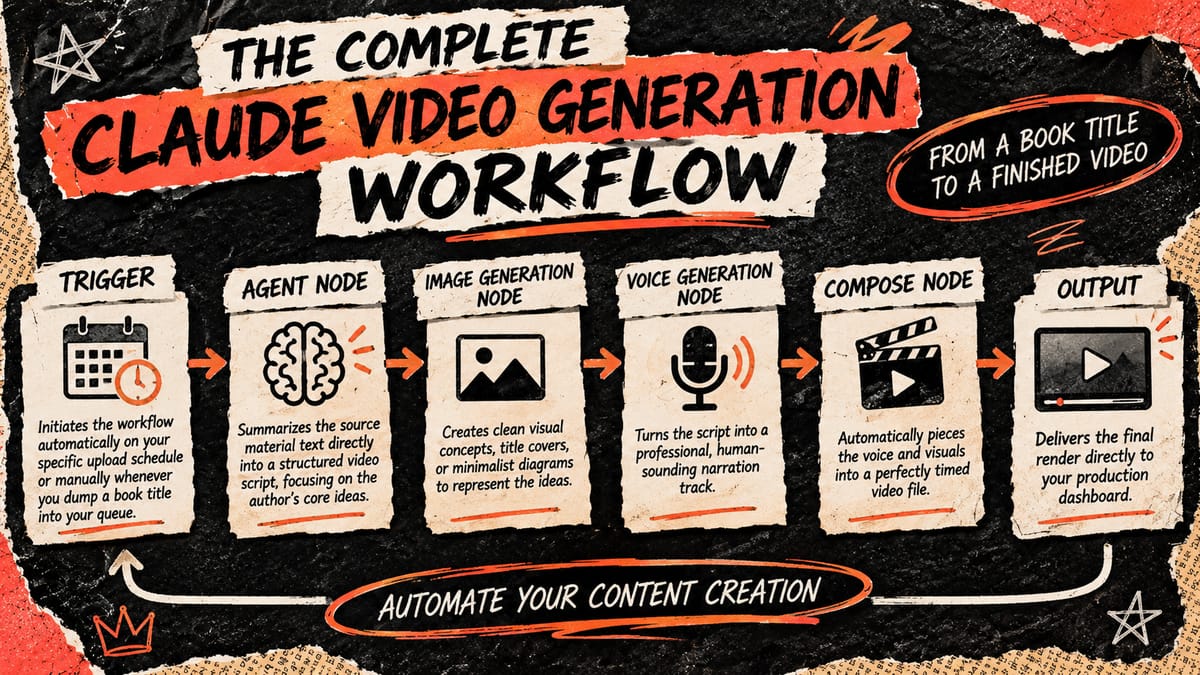
This workflow shows how to turn a book title into a finished video using connected AI nodes. This is just one example of a workflow, but the same structure applies to roughly 90% of AI content builds:
Trigger Node: Starts the workflow automatically on a schedule or manually.
Agent Node: Summarizes the source material and turns the author's core ideas into a script.
Image Generation Node: Creates visual concepts.
Voice Generation Node: Converts the script into professional, natural-sounding narration.
Compose Node: Combines the narration and visuals into a properly timed video.
Output Node: Delivers the finished video directly to your production dashboard.
Now that you have an idea of how these workflows are structured, let's look at the 70+ Faceless YouTube Channels that still work in today.
Animated Educational Explainers
This is one of the most durable formats on the internet. You take complex topics across science, history, or psychology, and break them down into short, highly visual, narrated explainers.
Who is doing it well: Kurzgesagt – In a Nutshell. They built a massive global brand entirely on animated science and philosophy explainers, without ever showing a single human presenter on screen.
To automate this process, you run everything through a single, continuous node chain built to handle dense, educational content:
Trigger: Kicks the workflow off, either automatically on a fixed schedule or manually whenever you are ready to produce a batch.
Agent Node: Researches your chosen topic and writes the complete script, handling the information exactly like a human researcher who spent hours reading about it first.
Image Generation Node: Creates the custom illustrated scenes and visual style the video will use based on the script.
Voice Generation Node: Turns the text script into a clean, clear narration track.
Compose Node: Automatically stitches the narration, illustrations, and timing together into an actual finished video.
Output Node: Delivers your completed, rendered file, fully ready to publish.
However, there is a massive catch you need to be aware of.
This is easily the single most competitive niche on the entire list. Because the audience expects high value, your success will come entirely from genuinely strong scriptwriting and unique illustration quality, not from flooding the platform with pure volume.
More channels in this space:
Channel | Handle | Concept | Subscribers |
|---|---|---|---|
@kurzgesagt | Animated science & philosophy | ||
@fern-tv | Investigative documentary journalism | ||
@ThePaintExplainer | Whiteboard "every X explained" catalogues | ||
@HeyHistorically | Dramatized history about bizarre events | ||
@EverythingProfessor | Systematic categorization content | ||
@FDOR | Caricature sports history documentaries | ||
@KnowingNoahYT | Anatomy & psychology comparisons | ||
@BluntlyExplained | Whiteboard physics & space | ||
@MackExplains7 | Stickman evolution & biology | ||
@Itzquanta | Doodle-style science explainers | ||
@brainosophic | Psychology of obscure emotions | ||
@TheVividen | Prehistoric creature content |
Book Summaries & Key-Idea Breakdowns
Non-fiction books are condensed into their core actionable ideas and narrated over simple, highly engaging visuals.
Who is doing it well: FightMediocrity. They built an audience of over 1.8 million subscribers by turning massive personal development and business books into short, visually animated summaries.
To build a channel like this efficiently, your node-based pipeline takes over the editorial heavy lifting:
Trigger: Initiates the workflow automatically on your specific upload schedule or manually whenever you dump a book title into your queue.
Agent Node: Summarizes the source material text directly into a structured video script, focusing entirely on extracting the author's core ideas rather than just reading chapter logs word-for-word.
Image Generation Node: Creates clean visual concepts, clean title covers, or minimalist diagrams to represent the abstract ideas on screen.
Voice Generation Node: Translates the analytical script into a professional, human-sounding narration track.
Compose Node: Automatically pieces the summary voice track and conceptual visual assets into a perfectly timed video file.
Output Node: Delivers the final completed render directly to your production dashboard.
However, there is a massive legal catch you must keep in mind with this format.
Copyright law matters immensely in the book publishing space. Summarizing big concepts and rephrasing ideas entirely in your own words is completely safe and falls under fair educational use.
Reading long, exact passages verbatim from a copyrighted book is absolutely not allowed.
You must be incredibly deliberate with the system constraints you give your Agent node before it writes a single paragraph.
Channel | Handle | Concept | |
|---|---|---|---|
@Antidote_thechannel | Structured audiobook summaries | ||
@greatbooksexplained371 | Business/self-help book lessons | ||
@Book_Pediaa | Illustrated book summaries | ||
@FightMediocrity | Business/self-help book lessons | ||
@MasterKeySociety | Business/self-help book lessons | ||
@littlebitbetter7 | Business/self-help book lessons | ||
@thebooktutor | Learn about books, math and computers | ||
@pagely700 | Business/self-help book lessons |
AI News & Tools Breakdowns
This format covers the latest AI tool releases, feature updates, and technical how-to guides. It is incredibly fast-moving and currently commands a massive wave of audience interest.
Who is doing it well: DIGITAL INCOME PROJECT. They scale their audience by teaching viewers how to leverage automation, frequently using emerging video layers like Seedance 2.5 to showcase what is technically possible without a human host
To automate an AI tutorial channel, your workflow needs to balance live software snapshots with fully automated narration layers:
Trigger: A schedulable spark that keeps the production line running automatically as fresh industry news breaks throughout the week.
Agent Node: Scours current tech stories, pulls documentation, and writes a step-by-step tutorial script.
Video Generation Node: Creates the corresponding on-screen visuals. This node either maps out simulated application interfaces using image engines or imports raw tool demonstrations.
Voice Generation Node: Translates the technical script into an authoritative, clear narration track.
Compose Node: Automatically layers the tool visuals directly over the voice track, timing the asset splits perfectly.
Output Node: Delivers a fully compiled video file, prepped and ready for immediate deployment.
However, there is a brutal logistical catch to this niche.
This specific category moves faster than almost any other sector in the creator economy. A pipeline layout or a saved template that isn't regularly re-run and updated with fresh model changes will go completely stale within a matter of weeks.
More channels in this space:
Channel | Handle | Concept | |
|---|---|---|---|
@parkerprompts | AI workflow breakdowns with AI-avatar host | ||
@10xincome | AI side-hustle content | ||
@digitalincomeproject | AI business workflows | ||
@isaacverse | AI video creation tutorials | ||
@conorcreates123 | AI filmmaking tutorials | ||
@isadoesai | AI-avatar vlogging |
Motivational & Self-Improvement Compilations
This format covers short, illustrated motivational content. It deep-dives into stoic philosophy, daily discipline, and psychological mindsets, usually leaning heavily into a clean, minimalist visual style.
Who is doing it well: easy, actually. They rocketed past 1 million subscribers by taking broad self-improvement concepts like quitting procrastination, building confidence, or waking up early, and breaking them down using a distinct, light-hearted animation style combined with few words.
To scale a self-improvement compilation channel, you can configure your automation pipeline to effortlessly manage the heavy asset generation:
Trigger: Kicks things off instantly, running automatically on your weekly upload schedule or manually whenever you feed a new philosophical theme into the queue.
Agent Node: Evaluates the target concept and writes the script, seamlessly pulling from historically verified quote libraries or specific psychological mindsets you give it.
Image Generation Node: Creates the corresponding visual assets, programmed explicitly to output a clean, minimalist illustration style to match the somber tone.
Voice Generation Node: Translates the written script into a calm, resonant, and deeply professional narration track.
Compose Node: Automatically stitches the narration audio, minimalist graphics, and text overlays into a completed video file.
Output Node: Delivers the finished render directly to your publishing dashboard.
However, there is a massive market catch you need to keep in mind.
This is arguably the single most saturated niche on this entire list by raw channel count. Plenty of channels already execute this format technically well.
What actually separates a channel that breaks through from one that gets buried isn't the software pipeline itself. It is discovering a specific, unique angle or establishing a highly distinct creative voice that makes your content feel fundamentally different from the dozens of other creators doing the exact same thing.
More channels in this space:
Channel | Handle | Concept | Subscribers |
|---|---|---|---|
@PhilosophiesforLife | Stoic/Jungian psychology | ||
@SocialPsychologyMasters | Relationship/social psychology | ||
@TheReBornMindset | Discipline & mindset | ||
@SpeakSaurabh | Aesthetic & personality psychology | ||
@incognitoCEO | Anime-style personal growth | ||
@realstoicjournal | Stoic quotes & routines | ||
@easyactually | Minimalist self-improvement |
Horror & Scary Story Narration
This highly addictive format pairs chilling narration of true-horror encounters, online mysteries, or classic eerie creepypastas with deeply atmospheric, dark visuals.
Who is doing it well: Mr. Nightmare. He stands as one of the longest-running, most universally recognizable figures in this space, having built an audience of over 7 million subscribers purely through voice-driven horror storytelling without ever revealing his identity.
To automate a horror narration pipeline, your node chain relies on an asset engine optimized for dark, long-form content:
Trigger: Starts your run automatically on a set schedule or manually whenever you dump a raw script outline or user submission into the system queue.
Agent Node: Takes a basic plot point or an online forum thread and handles the structural writing. It outputs a paced, suspenseful story script designed to hold attention.
Image Generation Node: Processes the story scenes to generate dark, atmospheric visual environments that mirror the unfolding plot.
Voice Generation Node: Translates the suspenseful text into a deep, gravelly, or perfectly paced narration track.
Compose Node: Automatically layers the slow-pan atmospheric visuals over the audio files, matching the dark timing perfectly.
Output Node: Delivers the fully rendered file straight to your production deck, ready for deployment.
However, there is a major structural catch you have to factor into your operational cost math.
In the horror niche, long-form content, typically videos spanning 20 minutes or longer, heavily outperforms shorter variations.
Because long runtimes are required to build genuine tension and maximize viewer retention, your video compute expenses per video will be significantly higher here than in almost any other category in this directory.
More channels in this space:
Channel | Handle | Concept | |
|---|---|---|---|
@mrnightmare | Narrated true-horror encounters | ||
@chillingscares | Internet mysteries & forum-thread narration | ||
@mr.nightscares | Ambient horror compilations | ||
@HorrorShortsParty | Animated horror stories and fictional scary encounters | ||
@ScaryPumpkin | Animated Hindi horror stories, supernatural fiction and horror podcasts | ||
@DarknessPrevails | Viewer-submitted scary stories, paranormal encounters and unexplained events | ||
@Poi | Reddit horror stories, internet mysteries, disturbing real-world events and true crime | ||
@TheTapeLibrary | Long-form documentaries about paranormal mysteries and unexplained phenomena | ||
@LighthouseHorror | Narrated creepypasta, fictional horror stories and first-person encounters | ||
@ChillingScaresCompilations | Extended compilations of disturbing internet footage, mysteries and horror content | ||
@JUSTCREEPY | Long-form narrated horror stories about paranormal encounters, skinwalkers and unexplained events | ||
@MJVHindiTales | Animated Hindi horror stories with psychological and supernatural themes |
Finance & Wealth Progression Breakdowns
his high-value format covers personal finance, wealth habits, and macroeconomic concepts. It is frequently framed as progression tiers ("Your Life at Every Income Level") or economic essays narrated over minimalist animations or whiteboard sketches.
Who is doing it well: Alux.com. They built a massive global brand with over 5 million subscribers by focusing on luxury lifestyles and wealth-building principles, utilizing slick visual graphics without ever using an on-screen host.
To automate a finance channel pipeline, you can configure your node chain to systematically handle data research and visual asset mapping:
Trigger: Kicks off your workflow automatically on a fixed upload schedule or manually whenever you feed a new economic concept or financial topic into your queue.
Agent Node: Researches the target macroeconomic or personal finance topic, structures the educational progression, and writes the complete script.
Image Generation Node: Creates clear data visualizations, charts, conceptual diagrams, or clean whiteboard-style illustrations that match the unfolding economic concepts.
Voice Generation Node: Translates the detailed script into an authoritative, professional, and trustworthy narration track.
Compose Node: Automatically stitches the financial voiceover, custom charts, and textual data layers into a fluid video file.
Output Node: Delivers the fully rendered, high-definition clip directly to your dashboard, ready to launch.
However, there is a serious compliance catch you must be aware of before publishing in this sector.
Financial content carries real-world regulatory and accuracy stakes.
A wrong figure, an unverified calculation, or an oversimplified claim regarding complex tax rules, credit card mechanics, or stock investing can actively mislead your audience.
This specific niche requires a significantly higher level of fact-checking rigor than almost any other category in this directory.
More channels in this space:
Channel | Handle | Concept | |
|---|---|---|---|
@darkledger13 | Animated wealth-progression tiers | ||
@CasuallyFinance | Stickman macroeconomic explainers | ||
@alux | Wealth habits & luxury lifestyle | ||
@chrisinvests | Beginner personal finance, whiteboard style | ||
@nickinvests | Retirement & savings animation | ||
@unclejohnfinancial | Retirement planning for 40+ | ||
@howreallyvideos | Celebrity-linked wealth breakdowns | ||
@Crayon_Capital | Whiteboard financial/geopolitical explainers |
Progression, Rank & Hierarchy Breakdowns
This fast-growing format packages information into distinct growth steps or competitive rankingslike "Your Life at Every Level of a Faceless YouTuber" or "Every Tier of Wealth Explained." The content treats structural tiers as a visible, step-by-step staircase that the viewer climbs from the bottom to the absolute top.
Who is doing it well: Finance With Ryan. He scales his channel by building highly addictive, cinematic storytelling progressions like "Your Life at Every Level of Hotel Suites," tracking the precise financial and psychological shifts at every single tier.
To automate a structural tier list or a multi-level progression video, your workflow focuses entirely on dividing data into sequential steps:
Trigger: Kicks the run off automatically on your weekly upload schedule or manually whenever you feed a new list of ranking criteria into the queue.
Agent Node: Takes your chosen topic, researches the structural hierarchy, outlines the criteria for each rank, and writes a tightly paced script that builds suspense as the viewer climbs the ladder.
Image Generation Node: Produces custom, color-coded tier cards, ranking graphics (like classic S, A, B, C tiers), or visual representations for every single milestone.
Voice Generation Node: Translates the analytical script into a confident, engaging narration track.
Compose Node: Automatically stitches the visual rank changes, text tier overlays, and voice files together into a perfectly synchronized video.
Output Node: Delivers the fully rendered file straight to your production deck, ready for deployment.
However, there is a massive conceptual catch you have to look out for.
This specific format lives or dies entirely on a clean, satisfying structure. If your tier system feels poorly defined, your ranking criteria seem vague, or the jumps between milestones feel wildly uneven, it completely undermines the appeal of the video.
With this style of content, the clean progression is the hook. If the staircase feels broken, your viewer retention will plummet.
More channels in this space:
Channel | Handle | Concept | |
|---|---|---|---|
@LadderTheoryREAL | Career-ladder breakdowns | ||
@ChillPovGuyTV | Blue-collar job hierarchy | ||
@CasuallyFinance | Minimalist macroeconomic & percentiles | ||
@RyanFinanceUS | Second-person POV wealth ladders | ||
@POVrank | High-pressure organizational ladders | ||
@darkledger13 | Animated wealth-progression tiers |
Mascot-Driven Metaphor Explainers
This highly viral format breaks down complex topics like corporate economics, regional geopolitics, or quantum physics through a recurring cartoon animal or character mascot. The system translates dry, high-level terminology into simple analogies (like using "bananas" to explain global crude oil supplies or central bank inflation), making heavy subjects instantly approachable.
Who is doing it well: Primate Economics. They exploded past 570K subscribers by explaining complex macroeconomic models entirely through a cartoon monkey character navigating market choices using bananas as currency.
To automate a mascot-driven explainer channel, your pipeline must balance detailed metaphor generation with absolute asset consistency:
Trigger: Starts the run automatically on a fixed calendar schedule or manually whenever you supply a new research topic to your dashboard.
Agent Node: Takes a dense academic or news topic, strips out technical jargon, and writes a highly creative script structured entirely around an extended visual metaphor.
Image Generation Node: Produces the animated frames, heavily constrained by a locked visual style pack to keep your recurring mascot character looking identical from scene to scene.
Voice Generation Node: Translates the creative script into a highly expressive, clear narration track that matches the lighthearted tone of the visuals.
Compose Node: Automatically synchronizes the voice track, character gestures, text overlays, and sound effects into a finished video file.
Output Node: Delivers the fully rendered clip directly to your media queue, ready to publish.
However, there is a massive technical catch to this niche.
Character consistency across every video is incredibly difficult to maintain with basic generative AI. Your mascot must retain the exact same facial proportions, colors, and design style from episode to episode.
More channels in this space:
Channel | Handle | Concept | |
|---|---|---|---|
@primateeconomics | Economics via animal mascots | ||
@monkeymind-101 | Psychology via mascot | ||
@MonkeyExplains1999 | Geopolitics via mascot | ||
@Primatescience | Physics via mascot |
Historical, Archival & Military Documentaries
This premium format covers real historical events, military history, or corporate rise-and-fall stories. The content is packaged as immersive, cinematic mini-documentaries narrated over archival-style imagery, custom tactical maps, and aged documents.
Who is doing it well: MagnatesMedia. They built an audience of over 1.8 million subscribers by producing high-end corporate documentaries tracking the dark histories, scandals, and massive wealth empires of global brands, using entirely voiceover and dramatic visual editing.
To automate a high-retention documentary channel, your node-based pipeline must be optimized to cross-reference facts and handle era-specific visual styling:
Trigger: Initiates the generation process automatically on your fixed upload schedule or manually whenever you supply a historical figure, battle, or company name to the queue.
Agent Node: Gathers detailed historical timelines, cross-checks academic archives, and drafts a compelling, chapter-based documentary script.
Image Generation Node: Creates vintage, archival-style visuals, localized battle maps, or period-accurate sketches that mirror the historical era.
Voice Generation Node: Translates the detailed case study into a deep, commanding, or perfectly paced cinematic narration track.
Compose Node: Automatically layers the period visuals, subtle camera pans, text titles, and dramatic background music over the voice track.
Output Node: Delivers a fully compiled, long-form documentary file straight to your production deck.
However, there is a strict editorial catch you must enforce in your system instructions.
Just like true crime, historical content carries an absolute requirement for research accuracy. The workflow can easily automate the visual rendering and the voiceover, but the underlying historical research must be pulled from real public records. You cannot allow the script-writing step to hallucinate or invent dates and details unsupervised.
More channels in this space:
Channel | Handle | Concept | |
|---|---|---|---|
@AgentFlappy | Mascot-hosted presidential history | ||
@WW2Tales | Archival WWII narratives | ||
@ravelin.history | Tactical siege history | ||
@magnatesmedia | Corporate rise-and-fall documentaries | ||
@companyman114 | Brand decline case studies |
Ambient, Sleep & Audio-First Content
This format produces long-form, ultra-calm content typically running 1.5 to 3 hours. It covers history documentaries, deep science, or gentle audiobook-style narrations designed specifically for background listening, bedtime rest, or study sessions rather than active watching.
Who is doing it well: History After Dark . They built an audience of over 73K subscribers by producing two-hour "Bedtime History Documentaries" designed for passive listening, capturing tens of thousands of views per upload with only 39 total videos.
To automate an ambient sleep channel, your node pipeline needs to prioritize script length and vocal pacing over rapid-fire scene cuts:
Trigger: Starts the run on a schedule or manually whenever you queue up a broad historical or scientific topic.
Agent Node: Writes an extended, chapter-based script structured specifically for low-cognitive-load, sleepy pacing. It removes dramatic cliffhangers and maintains a smooth, even narrative tone throughout.
Image Generation Node: Creates minimal, slow-panned visuals or recurring atmospheric scenes, such as dimly lit libraries, starry skies, or soft historical paintings, rather than hundreds of frantic cuts.
Voice Generation Node: Narrates the text at a noticeably slower, steady, and soothing pace using a warm voice model.
Compose Node: Automatically stitches the multi-hour narration track, ambient background textures (like gentle rain or low-frequency soundscapes), and slow visual pans into a single video file.
Output Node: Delivers the finished, long-form render directly to your production dashboard.
However, there is a major financial catch you must factor into your operational plan.
This is the one niche where video length itself changes your cost math completely. Generating voice narration and rendering visuals for a two-hour video costs meaningfully more in raw compute than producing a standard 8-to-10-minute piece.
Your cost-per-view calculation will look fundamentally different from every other category in this directory.
More channels in this space:
Channel | Handle | Concept | |
|---|---|---|---|
@SleeplessHistorian | Long-form narrative history for sleep | ||
@SleepyScienceChannel | Long-form relaxing science facts | ||
@chathistorycompilations | Long-form historical compilations |
Fitness, Anatomy & Special-Interest Explainers
This broad category covers specialized domains like body and anatomy science, calisthenics mechanics, and niche hobbies like geography, pet keeping, food history, and interactive trivia formats. These areas are united by narrow, highly targeted, specific-interest framing rather than broad mass appeal.
Who is doing it well: Zack D. Films. He built one of the largest short-form brands on the internet with over 28.5 million subscribers entirely on 3D-animated anatomical quirks and scientific oddities, without ever using an on-screen host.
To automate a niche science or hobby channel, you can configure your workflow pipeline to balance detailed reference gathering with custom visual rendering:
Trigger: Initiates the workflow automatically on a set upload schedule or manually whenever you dump a technical fact or specialized sub-niche idea into your queue.
Agent Node: Researches the narrow topic, cross-references anatomical or historical facts, and writes a tightly paced script built around a singular fascinating revelation.
Image or 3D Generation Node: Produces the custom visual assets, shifting between standard image mapping or 3D engine generations depending on what your specific sub-niche requires to explain the concept.
Voice Generation Node: Translates the educational script into a punchy, highly energetic, and clear narration track.
Compose Node: Automatically layers the 3D visual sequences, zoom pans, and audio tracks together into a completed short or long-form video.
Output Node: Delivers the fully rendered file directly to your platform manager, ready to publish.
However, there is a major operational catch to this format.
This is easily the widest and most varied category on the entire list. Because the sub-niches are so distinct, your actual software workflow and cost layout will differ significantly depending on what topic you choose.
For example, rendering medical-grade anatomical content demands high-fidelity 3D modeling nodes that cost significantly more in compute time than generating a basic vector layout for a quick interactive trivia game. You must treat the "one uniform workflow" framing here much more loosely than the other eleven categories in this directory.
More channels in this space:
Channel | Handle | Concept | Subscribes |
|---|---|---|---|
@zackdfilms | 3D anatomical/medical facts | ||
@yellowdude_co | Calisthenics mechanics | ||
@captainworkoutTV | Muscle/longevity science | ||
@CalisthenicsWithLavender | Calisthenics for women | ||
@LifeAccordingtoScience | Stickman science/psychology |
None of these fit? Here's a faster path than inventing something new
Most niche directories treat every format as if it is permanently glued to its topic.
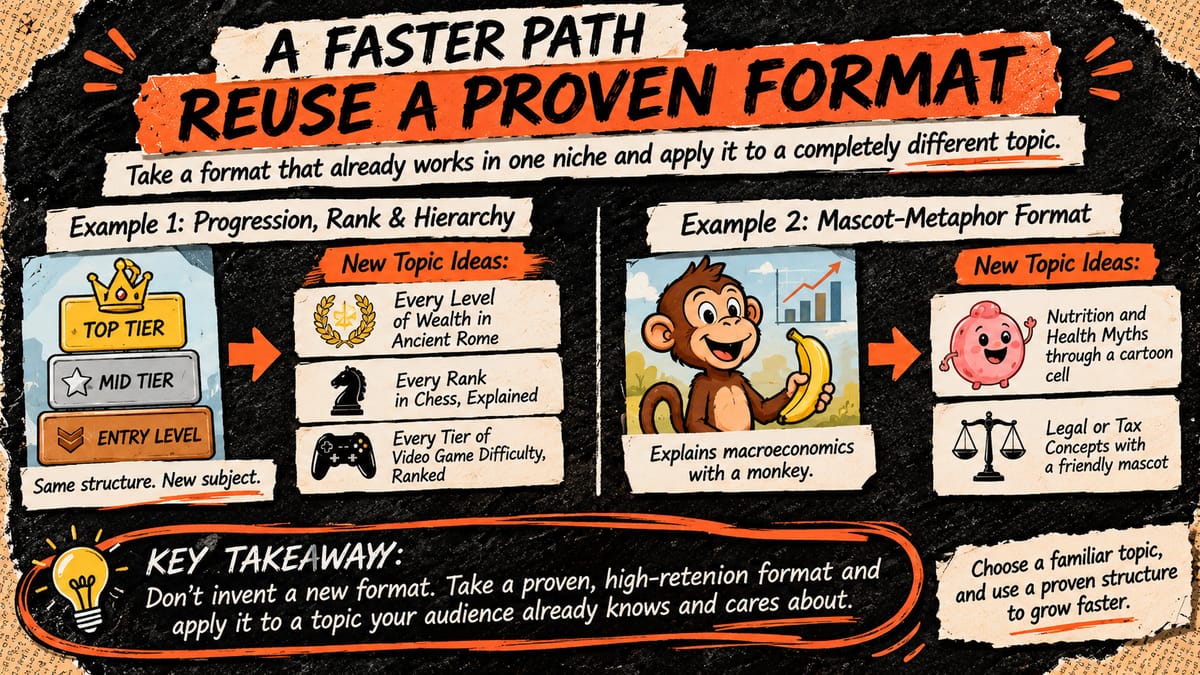
There is a real, established growth technique worth knowing before you give up and try to invent a system from scratch: take a format that is already proven in one topic, and move it into an entirely different topic where nobody is using it yet.
Here is a concrete example. The "Progression, Rank & Hierarchy" format is currently built almost entirely around blue-collar jobs and career salary ladders. Nothing about that visual structure is specific to modern employment.
You can point that exact same framework at:
"Every Level of Wealth in Ancient Rome" (Moving the format to historical empires instead of careers)
"Every Rank in Chess, Explained" (Moving the format to board game mechanics instead of careers)
"Every Tier of Video Game Difficulty, Ranked" (Moving the format to gaming culture instead of careers)
It uses the exact same script structure, the same visual rank cards, and the same hook just with a completely different subject wearing it.
Look at a second example. The mascot-metaphor format currently explains macroeconomics through an animated monkey trading bananas. Our directory already shows this same structure jumping successfully into physics and geopolitics. It will work just as well for:
Nutrition and Health Myths: Explained step-by-step through a friendly, animated cartoon cell or organ character.
Legal or Tax Concepts: The exact kind of dry, high-barrier topic that benefits the absolute most from a cartoon mascot doing the heavy explaining.
If none of those twelve individual niches align with your goals, choose the faster path.
Do not try to invent a brand-new format.
Take an existing, high-retention format and apply it to a new topic. To build audience trust quickly, make sure you choose a topic that viewers already recognize, like a well-known historical event, a major sports league, or a household corporate name.
FAQ
Do I need to show my face for any of these?
No, every format above is built entirely on script, voice, and generated or existing visuals.
Can I run more than one niche at once?
Yes. You can create and run multiple niches at the same time. The only limitation is how many workflows you can run simultaneously, depending on your plan. Free: Build workflows, but cannot run them. Starter: Run 2 workflows simultaneously. Pro: Run 5 workflows simultaneously. Scale: Run 15 workflows simultaneously. Studio: Run 20 workflows simultaneously, with the option to expand
Which niche should I start with?
I'd recommend starting with Progression, Rank & Hierarchy Breakdowns, but with a specific topic rather than a generic channel.
- AI Guide
Was this helpful?


