How to Become a Content Creator in 2027
Most creators quit for the same reason: they skip ahead before they're ready. Only 4% ever make six figures. Here's the system that changes the odds.


TL;DR
- Stage 1: The Beginner: You have no audience, no brand, and no system.
- Stage 2: The Growth Phase: You have found your niche and you post consistently.
- Stage 3: The Professional: You have a real audience, brands are noticing you.
- Stage 4: The Scaling Phase: You are making real income, but you are stretched incredibly thin.
- Stage 5: The Legacy Brand: You are a full-scale media brand, not just an individual creator.
Most guides to becoming a content creator give you one generic list of advice for everyone. They tell you to buy the same ring light, download the same heavy editing software, and follow the exact same checklist. That is the problem.
A creator with zero videos and a creator earning real brand deals operate in two completely different worlds. They need completely different tools.
To survive the creator journey, you must match your tools to your current stage.
This article breaks down exactly what you need at each phase.
You will discover the precise moment an AI workflow becomes worth your time and when it is simply a distraction.
Why do most new creators quit?
A new creator watches a video about growing to 100,000 followers.
That video mentions posting schedules, thumbnail testing, email funnels, content repurposing,ect. The new creator tries to implement every single bit of it in week one.
They spend 40 hours setting up complex software systems for a channel that currently has zero videos. Three weeks later, they have only posted twice, and they feel like a total failure. This is stage-jumping, the primary reason most creators quit before they ever build momentum.
Only about 4% of creators globally earn more than $100,000 a year, according to Goldman Sachs.
The gap happens because of stage confusion.
Trying to manage complexity without the foundational content to support it only creates confusion and grinds your momentum to a halt.
What are the 5 stages of a content creator?
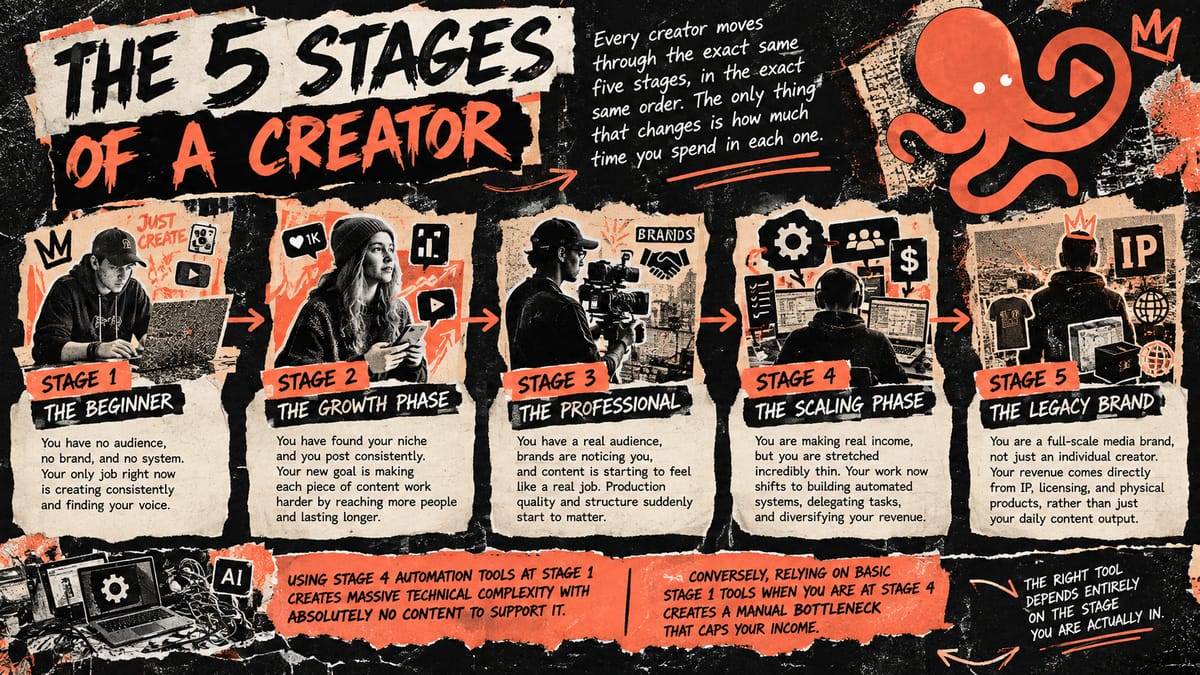
Every creator moves through the exact same five stages, in the exact same order. The only thing that changes is how much time you spend in each one.
Stage 1, The Beginner: You have no audience, no brand, and no system. Your only job right now is creating consistently and finding your voice.
Stage 2, The Growth Phase: You have found your niche and you post consistently. Your new goal is making each piece of content work harder by reaching more people and lasting longer.
Stage 3, The Professional: You have a real audience, brands are noticing you, and content is starting to feel like a real job. Production quality and structure suddenly start to matter.
Stage 4, The Scaling Phase: You are making real income, but you are stretched incredibly thin. Your work now shifts to building automated systems, delegating tasks, and diversifying your revenue.
Stage 5, The Legacy Brand: You are a full-scale media brand, not just an individual creator. Your revenue comes directly from IP, licensing, and physical products, rather than just your daily content output.
Your current stage dictates what you should primary focus on. Success comes from matching your energy to where you actually are today.
Stage 1: What should a beginner focus on?
Your only goal at this stage is to create 30 pieces of content.
Do not try to go viral. Do not try to monetize. Just focus entirely on hitting the publish button.
Your first 10 videos teach you the actual format. Your next 10 videos teach you your unique voice. The final 10 videos finally teach you what your audience actually responds to.
What matters here is incredibly simple:
A Clear Niche: Use a basic topic pool. Free tools like Google Trends work perfectly fine for this.
Basic Scripting: Write a rough outline to keep your videos from rambling.
Watchable Editing: Use the free tiers of CapCut or DaVinci Resolve. Focus on one simple cut, clean audio, and clear on-screen captions.
The classic Stage 1 mistake is buying expensive generative video tools, complex AI avatars, and advanced scheduling platforms before you have posted a single video. None of that software helps you find your voice. Post first. Optimize later.
Stage 2: When does repurposing and scheduling start to matter?
Once you have posted consistently and truly know your niche, your goal shifts completely.
You move away from trying to create more raw volume, and start focusing on making what you already create go much further. A single long-form video can fuel your entire weekly engine.
You can slice that one file into three separate TikToks, a Reel, a LinkedIn post, and a newsletter edition. This is also where your scheduling stops being random and starts being highly strategic.
You begin posting precisely when your audience is actually online, while actively tracking which formats get shared rather than just liked.
If you are building specifically toward a faceless YouTube channel, this is the exact stage where content batching and automated scheduling become your real leverage points. It is well worth taking a deeper look into how to actually build that automated pipeline.
However, there is a massive mistake to avoid.
Many creators fall into the trap of heavily repurposing content that they haven't actually validated yet. Repurposing a low-performing video just spreads a bad piece of content further.
You must make sure the core content works first.
Stage 3: When does generative AI video actually become worth it?
This is the exact stage most online guides get incredibly vague about.
At Stage 3, you have a real audience and a distinct, verified voice already established. That is exactly when AI avatars, generative video platforms, and automated workflows stop being generic gimmicks and start amplifying something that already exists.
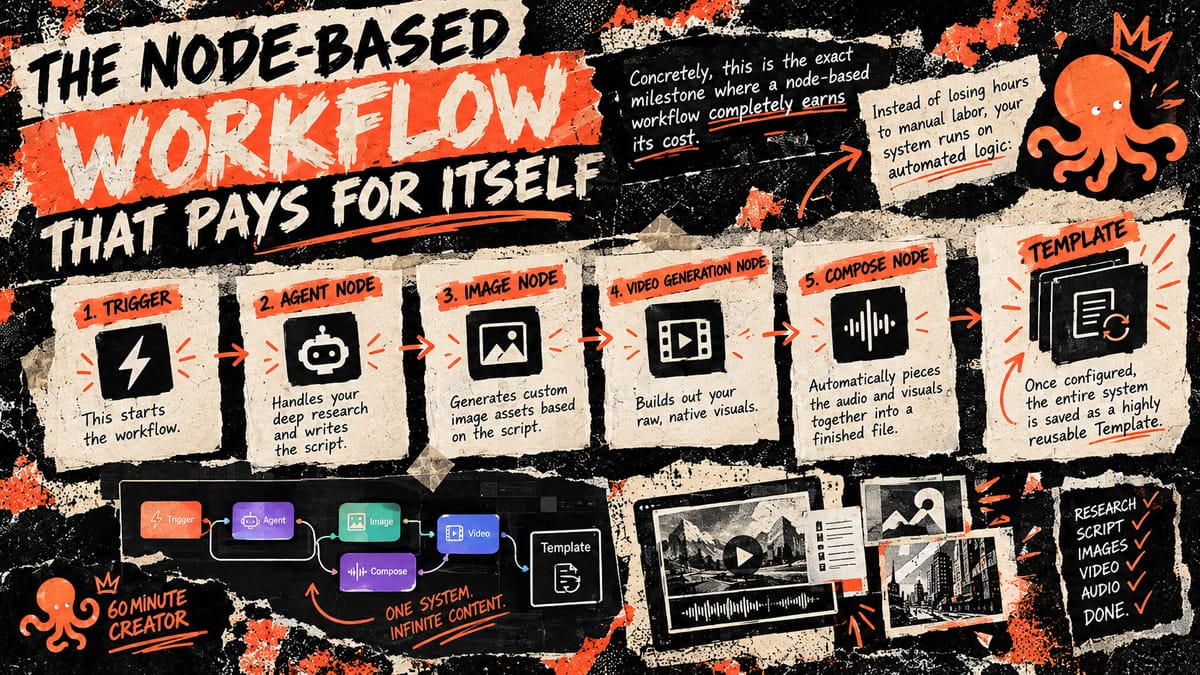
This is the exact milestone where a node-based workflow completely earns its cost.
You no longer need to spend hours manually managing your pipeline.
Instead of losing hours to manual labor, your system runs on automated logic:
Trigger: This starts the workflow.
Agent Node: Handles your deep research and writes the script.
Image Node: Generates custom image assets based on the script.
Video Generation Node: Builds out your raw, native visuals.
Compose Node: Automatically pieces the audio and visuals together into a finished file.
Once configured, the entire system is saved as a highly reusable Template.
The traditional multi-tool software stack requires one separate subscription each for scripting, voice, video generation, and editing. That runs you between $103 and $122 a month, completely regardless of whether you publish 3 videos or 13.
An automated workflow connected directly to your own infrastructure provider accounts changes the economics. You are billed purely per generation at real, raw rates like $0.23 per second for the Seedance 2.5 model. You only pay for what you actually make.
But, here is what actually matters at this stage:
Don't fix what isn't broken. If your simple, two-tool setup is already making good money and keeping you consistent, don't waste time rebuilding everything just because a shiny new automation tool exists.
Only automate when you need to scale. Moving to a complex system only makes sense when your video volume explodes, or when you need to swap different AI models to get the best price and quality. It is not a rule that every creator has to follow.
The classic Stage 3 mistake is skipping straight here directly from Stage 1.
A generative AI avatar or a hyper-optimized automated workflow cannot fix a channel that has absolutely no clear niche. You must build the creative foundation first.
Stage 4: How do creators scale past doing everything themselves?
You are finally earning a real income.
However, you are also stretched incredibly thin, and you can no longer manage everything entirely on your own. This is the exact milestone where income concentration becomes a massive, dangerous risk.
According to a report by CreatorIQ, based on actual transaction data across 65,000 brand payments, income inequality in the creator space is skyrocketing.
The top 10% of creators captured 62% of all advertising payments in 2025, up from 53% in 2023. Even more intense: the top 1% alone took home 21% of that entire pool.
Relying heavily on a single revenue stream means one lost partnership can completely collapse your entire income overnight. To protect your business, you must create multiple ways revenue streams. Start offering subscriptions, memberships, or digital products.
This is no longer a choice, it's a must.
Content repurposing needs to become fully automated.
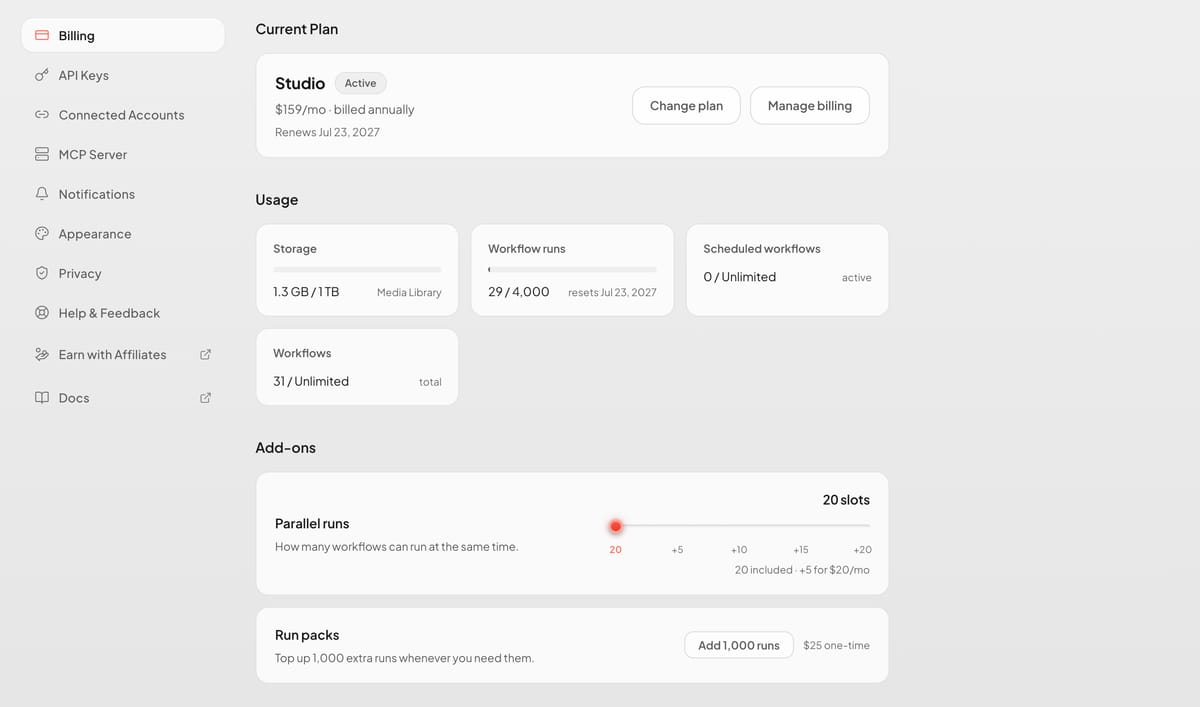
A single flagship video should generate a whole week of multi-platform content without you ever touching it. At this volume, running multiple workflows in parallel, rather than executing them one at a time, becomes the real technical bottleneck you need to solve.
However, there is a classic Stage 4 mistake you must avoid.
Many creators rush out to hire a massive human team before their revenue streams are actually diversified. Building a high-overhead team on top of a single, fragile income source doesn't make you safer. It simply scales your financial risk.
Stage 5: What does a creator-turned-media-company look like?
At Stage 5, you are no longer a content creator.
You are running a full-scale media company. Your revenue now flows directly from intellectual property (IP), strategic licensing, and distinct product lines.
These three real examples show exactly what this looks like in practice:
Premium Streaming Licensing: Children's creator Ms. Rachel signed a massive distribution deal that brought a four-episode compilation season directly to Netflix. This expanded her foundational YouTube educational footprint into premium streaming platforms.
Physical Product Subscriptions: Former NASA engineer Mark Rober built CrunchLabs, a highly successful STEM subscription box company. This effectively transformed his massive YouTube channel into a physical product empire.
High-Tier Brand Equity: Khaby Lame, the world's most-followed TikToker, commands up to $750,000 per sponsored post. This allows him to clear an estimated $15 to $20 million a year by treating his personal brand as a global marketing agency.
These are three completely different paths. Yet, the common thread remains exactly the same: they built a structured business that runs entirely beyond the content itself.
How long does it actually take to make money as a creator?
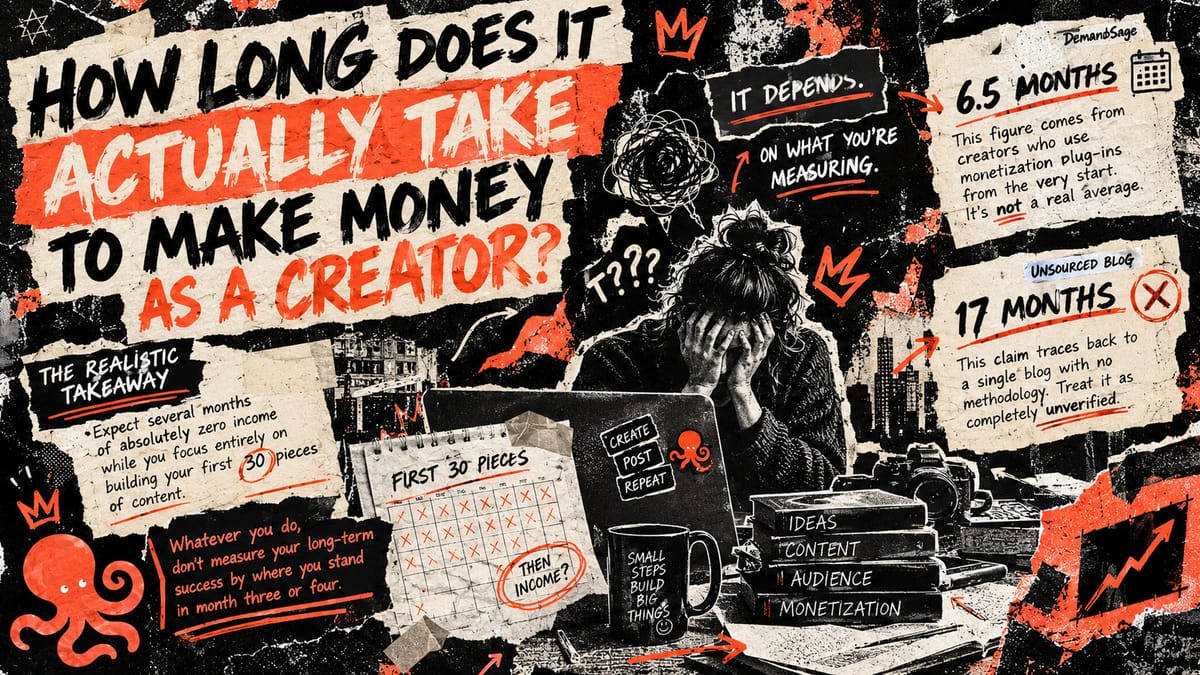
The truth depends entirely on how you measure the data.
A popular study from DemandSage says it takes six and a half months to earn your first dollar. However, this only counts people who set up payment tools on day one. It does not look at everyone who opens a new account. Most common numbers, are completely unverified.
The real lesson is simple.
Expect zero income for the first few months while you focus on making your first 30 videos. Do not judge your long-term success by where you are in month three or four.
FAQ
Do I need expensive tools to start?
No. Stage 1 needs a smartphone, free editing software, and free scripting help. Total cost should be $0 to $50.
When should I add AI-generated video to my content?
Once you have a real niche and consistent output, typically Stage 3. Adding it before that amplifies nothing, since there's no established voice yet to amplify.
How much do content creators actually make?
Only about 4% earn more than $100,000 a year, per Goldman Sachs. The median is far lower, and income is increasingly concentrated at the top, the top 10% now take 62% of all ad payments.
What's the biggest reason creators fail?
Stage-jumping, buying tools and building systems for a stage they haven't reached yet, before publishing enough content to know what actually works.
References
- Goldman Sachs Research, "The Creator Economy Could Approach Half-a-Trillion Dollars by 2027", April 19, 2023
- Grand View Research, "Creator Economy Market Size, Share | Industry Report, 2033", last updated June 2026
- CreatorIQ, "Top 10% of Creators Earned 62% of Payments in 2025 as Creator Compensation Inequality Widens", January 21, 2026
- Variety, "Ms. Rachel Sets Netflix Debut: Four Episodes to Stream in January", January 14, 2025
- Forbes, "Live From the 2024 Forbes Creator Upfronts", October 28, 2024
- CrunchLabs, official site
- DemandSage, "41+ Creator Economy Statistics 2026", Naveen Kumar, updated June 24, 2026
- AI Guide
Was this helpful?

