Hire a Video Editor or Automate With AI Actual Costs in 2027
Compare the real costs of hiring a professional video editor versus automating video production with AI.


TL;DR
- Upwork's own page shows $10-40/hr median across tiers, Fiverr shows $25-50/hr or $50-300 per edited video
- 30-90 minutes per short-form video for standard cuts, up to 2-3 hours for stylized work
- Roughly $3-6, verified directly against Seedance 2.0 and ElevenLabs pricing
- At moderate volume, the gap is real but narrower than most guides claim.
- 60 Minute Creator's real cost: subscription ($20-199/mo) plus no-markup generation
Most guides comparing human video editors to AI automation rely on incredibly vague estimates. They guess at the prices, play favorites, and leave you without real data.This guide changes that.
We checked both options directly against reality.
We pulled real human rates straight from the pricing pages of Upwork and Fiverr, and contrasted them against the exact, verified generation costs on the AI side.
What does a freelance video editor actually cost?
To find the true cost of human labor, we pulled the current rates directly from the major freelance platforms.
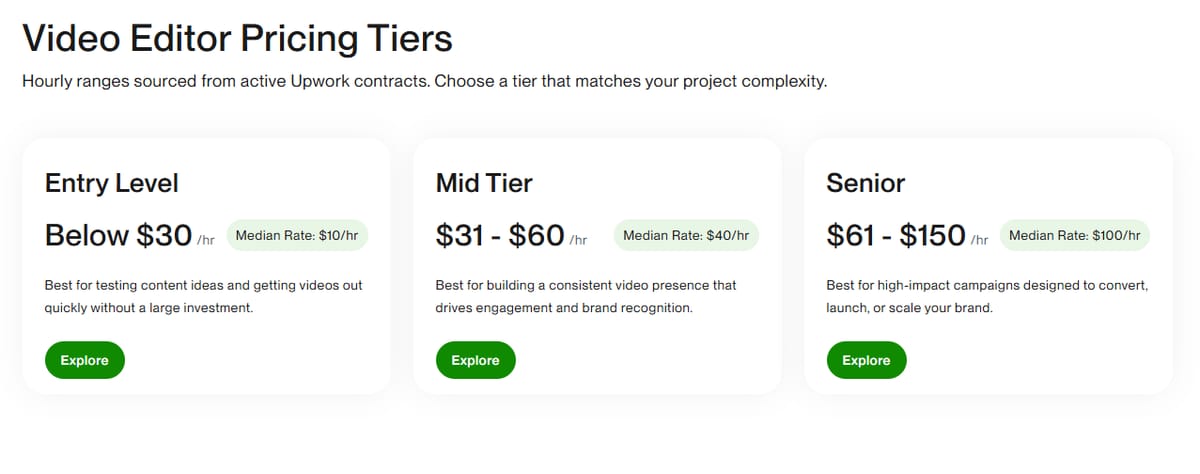
Source | Entry | Mid | Senior |
|---|---|---|---|
Upwork (median) | $10/hr | $40/hr | $100/hr |
Fiverr | - | $25-50/hr, or $50-300/video | - |
It is worth noting that Upwork's real, entry-level median rate runs meaningfully lower than the $25 to $50 hourly figure repeated across most guides on this topic. Checking the platform's actual data corrects a widely assumed number before you even begin budgeting.
How Long Does It Actually Take to Edit a Short-Form Video?
To get the real answer, we analyzed converging data across multiple independent sources.
Standard video editing generally runs 30 to 60 minutes per finished minute of video.
Simple talking-head or standard social-style cuts land on the faster side, taking about 20 to 30 minutes per finished minute. On the other hand, stylized, motion-heavy edits run much slower, often requiring an hour or more per finished minute.
For a typical 60 to 90-second short-form video, that works out to roughly 30 to 90 minutes of manual labor for a standard cut. That timeline easily climbs to two or three hours of intense work for something more heavily produced.
That is actually much lower than the flat "three to five hours per video" figure that many guides in this space assume. That inflated number appears to be lazily borrowed from long-form content and misapplied directly to short-form work.
What does automating this with AI actually look like?
Instead of juggling a script tool, a separate voice tool, and a manual editor, your entire production pipeline runs as a single, unified workflow. Everything starts with a Trigger. This spark kicks off the process either on a fixed automated schedule or manually whenever you are ready.
From there, the workflow handles the heavy lifting step-by-step:
An Agent Node researches your topic, formats the structure, and writes your hook.
An Image Generation Node automatically creates the images.
A Video Generation Node automatically produces your raw visuals.
A Compose Node automatically assembles the timing, visuals, and audio into a finished clip.
An Output Node delivers your completed file, ready to publish.
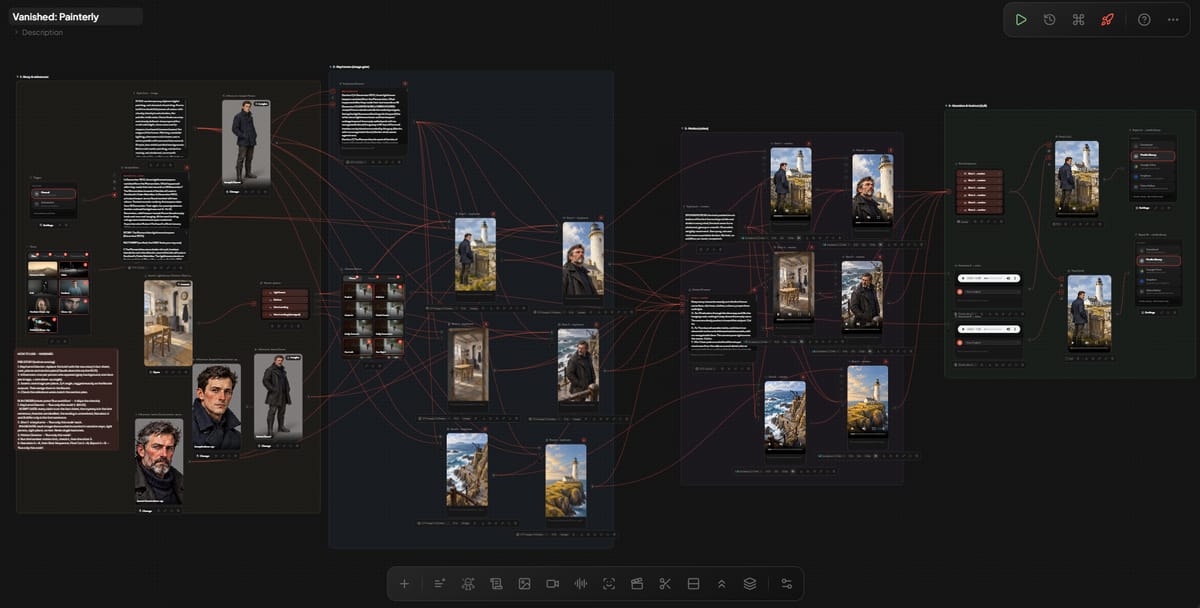
Once you build this pipeline once, you simply save the entire thing as a Template. Every future video becomes a matter of feeding in a single new topic, rather than rebuilding a pipeline or briefing a new human editor every single week.
The financial structure here is completely different too.
Content generation is billed directly by whichever infrastructure provider you choose to connect whether that is fal.ai, OpenRouter, Kie.ai, or Atlas Cloud. You pay for the exact compute you use at their real, raw rate, with absolutely zero markup added on top.
What does it actually cost to generate the same video with AI?
To find the true cost of automation, we look at the raw resource usage rather than arbitrary flat-rate packages. Your primary expenses come down to two components: video compute and voice generation.
Model | Rate |
|---|---|
Seedance 2.0, 720p | $0.09 to $0.1814/sec (Atlas Cloud to fal.ai) |
ElevenLabs voice | ~$0.01/sec equivalent |
When you break that down into finished assets, a standard 30-second video clip runs roughly $3 to $6 in raw generation costs, depending entirely on which specific provider you connect.
On top of those direct infrastructure costs, you pay a single flat monthly fee to cover the workflow and automation layer itself. This ranges from $20 to $199 a month, letting you select whichever tier scales naturally with your actual publishing volume.
So which one actually costs less?
For 15 short-form videos a month, assuming an average of 45 minutes of editing time per video at Upwork's mid-tier median rate of $40 an hour, hiring an editor runs around $450 a month.
The AI route requires a $20 to $199 monthly workflow subscription, plus roughly $45 to $90 in raw generation costs for those same 15 videos. That keeps you comfortably under $300 a month across most software tiers.
The financial gap is genuine, but it is much narrower than most online guides claim. It depends heavily on the specific editor tier you choose to hire. When measured against entry-level human rates, the two paths land much closer together than most AI software companies care to admit.
When does a human editor still make sense?
Here is the truth.
AI cannot handle custom color grading, intricate narrative pacing on long story-driven pieces, or brand-critical content where unique creative judgment is the core product.
If you are only producing one or two highly stylized pieces a month rather than trying to push out 15 consistent short-form videos, a skilled editor’s creative touch becomes the deciding factor.
At that scale, quality matters far more than pure execution speed.
FAQ
How much does a freelance video editor actually cost?
Real data from Upwork and Fiverr's own pages: $10 to $40/hr median depending on tier, or $50 to $300 per edited video on Fiverr specifically.
How long does it really take to edit a short video?
30 to 90 minutes for a standard 60 to 90 second cut, up to 2 to 3 hours for something more stylized, confirmed across multiple independent editing-time sources.
Is AI video generation actually cheaper than hiring an editor?
At volume and against mid-tier editor rates, yes, meaningfully. Against entry-level rates specifically, the gap narrows.
Does a cheaper editor mean worse quality?
Not necessarily, but revision risk and consistency tend to track with rate tier, worth factoring in alongside the raw hourly number.
References
- AI guide
Was this helpful?


